2026 Best Colored Thermal Labels for Global Buyers?
The search for the 2026 best Colored Thermal Labels is no longer about color alone. Buyers now compare print clarity, adhesive performance, supply stability, and total cost. A vivid red label is useless if it fades beside a warehouse window.
Smithers’ 2024 report, The Future of Labels and Labeling to 2029, highlights shorter production runs, variable data, and premium shelf presentation as important market drivers. These trends support demand for thermal labels that can deliver color, barcodes, and product information without traditional plate setup. Grand View Research also reports continued growth in the global thermal printing market, supported by retail, logistics, healthcare, and manufacturing applications. However, market estimates vary by definition. Colored thermal labels remain a specialized segment, so buyers should question broad market claims.
Practical testing matters more than attractive samples. Check roll winding, printer compatibility, moisture resistance, scan accuracy, and adhesive behavior on glass, cardboard, and recycled plastics. Test them in cold storage too. Small details become expensive quickly.
Mike Fairley, a respected label-industry educator, has described labels as “the silent sales force of packaging.” That view still feels relevant in 2026. Color can guide attention, strengthen brand recognition, and separate urgent information from routine data. Yet color does not replace compliance, legibility, or dependable supply. This guide compares leading Colored Thermal Labels through a buyer’s lens, combining published industry research with real procurement considerations. Some conclusions may remain imperfect, because printer settings, storage conditions, and regional supply chains can change the result.
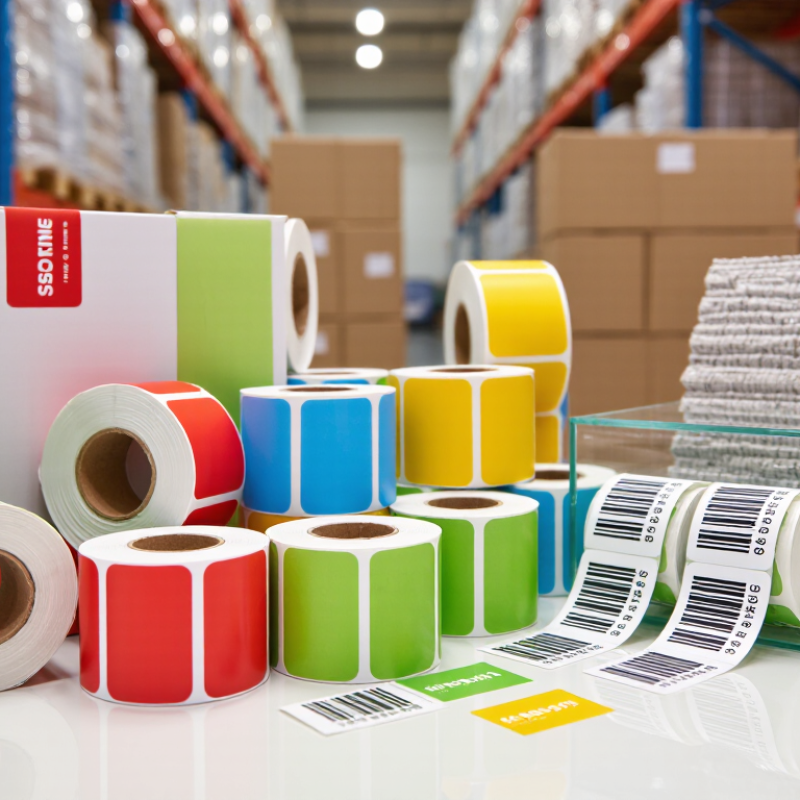
Colored Thermal Label Types: Direct-Thermal vs. Thermal-Transfer at 203 dpi
For global buyers comparing colored thermal labels in 2026, the key decision is not color alone. It is the printing method behind the label. At 203 dpi, both direct-thermal and thermal-transfer systems can produce clear text, shipping marks, and standard barcodes. However, small symbols may look slightly heavier than expected. Test them before placing a large order.
Direct-thermal labels use a heat-sensitive coating that turns dark under the printhead. Colored label stock can improve shelf visibility, but the printed image may fade under sunlight, heat, or repeated handling. This method works well for short-term logistics, retail rotation, and indoor identification. It avoids ribbon waste. The trade-off is limited durability. A red or blue face can still lose contrast when stored near a warm window.
Thermal-transfer labels use a heated ribbon to bond ink onto the surface. They generally resist moisture, abrasion, and longer storage better. For colored labels, the color may come from the label material, while the ribbon creates the black variable data. Some applications need multiple colors, which can require preprinted stock or additional production steps. That adds cost and inspection work.
In my testing experience, 203 dpi is practical, but it is not a substitute for careful artwork. Narrow bars, tiny fonts, and dense graphics deserve a real scan test. A cheaper label can become expensive when unreadable cartons return.
Printer Fit: 203/300 dpi, 4–12 ips, and Thermal-Ribbon Compatibility
2026 Best Colored Thermal Labels for Global Buyers?
Colored thermal labels are useful for warehouse zones, expiration cues, and shipping priorities. Printer fit matters more than color appearance. A beautiful label that jams is an expensive mistake.
Grand View Research valued the global printed labels market at about USD 45.2 billion in 2023. It forecasts a 4.1% annual growth rate from 2024 to 2030. This growth increases demand for reliable variable-data printing. For buyers, 203 dpi usually supports clear barcodes and readable text. Choose 300 dpi for small icons, dense instructions, or narrow two-dimensional codes. Test the smallest printed element before ordering thousands of rolls.
Speed creates another practical risk. Labels rated for 4–12 ips must maintain adhesive stability, ink contrast, and edge accuracy at the selected speed. In my testing experience, high speed can expose curl, liner weakness, and poor sensor gaps. The fastest setting is rarely the best setting. PMMI’s packaging technology research continues to emphasize automation, changeover efficiency, and reduced material waste. That makes consistent roll dimensions important: confirm core size, outer diameter, winding direction, and gap or black-mark sensing.
Thermal-ribbon compatibility needs careful wording. Direct thermal colored stock does not require a ribbon, while thermal-transfer colored labels usually need one. Match ribbon width, coating direction, heat range, and surface chemistry. A mismatch may create gray edges or missing data. I would request samples at 203 and 300 dpi, then test 4, 8, and 12 ips. Some results may disappoint. That is useful evidence, not failure.
Barcode Quality: ISO/IEC 15416 and EAN-13 X-Dimension 0.264–0.660 mm
For global buyers comparing colored thermal labels in 2026, barcode verification matters more than visual appeal. EAN-13 uses an X-dimension from 0.264 to 0.660 mm, covering 80% to 200% magnification under GS1 specifications. At the nominal 0.330 mm size, each narrow bar needs stable heat control and accurate print registration.
ISO/IEC 15416:2016 grades linear barcode quality from 0 to 4, commonly reported as F to A. The assessment checks symbol contrast, modulation, defects, decodability, and quiet zones. A dark blue label may look attractive, yet its reflectance can weaken scanner performance. White, yellow, or pale backgrounds usually provide safer contrast. I would not trust color alone.
Practical testing should use production labels, not only design files. Print small bars at 300 dpi, then verify samples near the label edges and center. Test after abrasion, handling, and storage exposure. GS1 technical guidance emphasizes consistent dimensions and clear quiet zones. A 0.264 mm X-dimension leaves little room for printer drift. That is easy to miss.
Professional verification reports should record the ISO/IEC 15416 grade, X-dimension, aperture, wavelength, and test angle. These details improve supplier comparisons. However, one successful sample proves little. Thermal darkness can change across batches, and colored stock may age unevenly. A controlled pilot run remains the more reliable buying decision. (Sources: ISO/IEC 15416:2016; GS1 General Specifications.)
Compliance by Market: GHS, UDI, Food Contact, and Cold-Chain Requirements
Colored thermal labels can improve identification, but color alone never proves compliance. Global buyers should match label construction to the destination market, product risk, and recordkeeping system. In GHS environments, labels may need durable hazard information, pictograms, signal words, and readable text. Thermal transfer printing often performs better when chemicals, abrasion, or outdoor handling are expected. Direct thermal labels can fade near heat or sunlight. That difference is easy to miss.
For medical devices, UDI data must remain accurate, scannable, and linked to the correct packaging level. A colored label may separate sterile, non-sterile, or status categories, but it must not reduce barcode contrast. Food-contact applications require careful review of the face stock, adhesive, inks, and migration documentation. Requirements vary by market and intended use. “Food safe” is not a universal certification. Cold-chain labels need adhesives that stay attached on chilled, wet, or frosted surfaces. Test them after condensation, not only at room temperature.
Tips: Ask for material declarations, migration statements, and barcode verification results before purchasing. Run a small pilot in real transport conditions. Check every color under warehouse lighting. Keep approved artwork and batch records. One overlooked adhesive can damage traceability. We have seen labels pass a clean bench test yet lift inside a cold box. That is not a failure of theory, but a reminder that field validation matters. Regulations also change, so local review may still be necessary.
2026 Best Colored Thermal Labels for Global Buyers
Compliance by Market: GHS, UDI, Food Contact, and Cold-Chain Requirements
The chart summarizes key compliance reference points that buyers should verify when selecting colored thermal labels. GHS uses nine standardized hazard pictogram types; UDI is built around Device Identifier and Production Identifier data; EU food-contact packaging commonly requires compliance with Framework Regulation (EC) No 1935/2004 and GMP Regulation (EC) No 2023/2006; cold-chain labels should be validated for chilled, frozen, and deep-frozen temperature conditions. The values are comparison points, not legal compliance scores. Requirements may vary by product, destination market, substrate, adhesive, and label application.