Choosing the right jute sack for global sourcing requires more than comparing prices. The sack must suit the product, shipment route, storage conditions, and handling process.
Jute packaging specialist Dr. T. K. Bose states, “A sack must be selected for the product, route, and handling reality.” This principle remains practical for importers, wholesalers, and agricultural suppliers. A sack filled with rice faces different demands from one carrying coffee beans, cocoa, grains, or natural fibers.
Start with the fabric’s construction. Check the weave density, yarn strength, stitching quality, and sack dimensions. Hold the material toward bright light. Uneven gaps may reveal weak sections. Rub the surface gently. Excessive fiber shedding can create problems during filling and transport.
Moisture protection needs careful attention. Standard jute sack fabric is breathable, but it does not create a waterproof barrier. For humid routes, buyers may need an inner liner, laminated surface, or controlled warehouse storage. Ignoring this detail can damage otherwise good packaging.
Ask suppliers for samples, test records, production photographs, and clear tolerances. Confirm the actual weight, mouth design, closure method, and bale quantity. A low quotation can become expensive when sacks split during loading.
Sourcing is rarely perfect. Even experienced buyers sometimes overlook stitching consistency or regional humidity. That is why a small trial order deserves serious attention. Inspect filled sacks, stack them, move them, and review their condition after several days.
A reliable jute sack supplier should communicate openly about fiber quality, customization limits, lead times, and inspection procedures. This guide examines those practical details, helping global buyers make decisions based on performance rather than appearance alone.
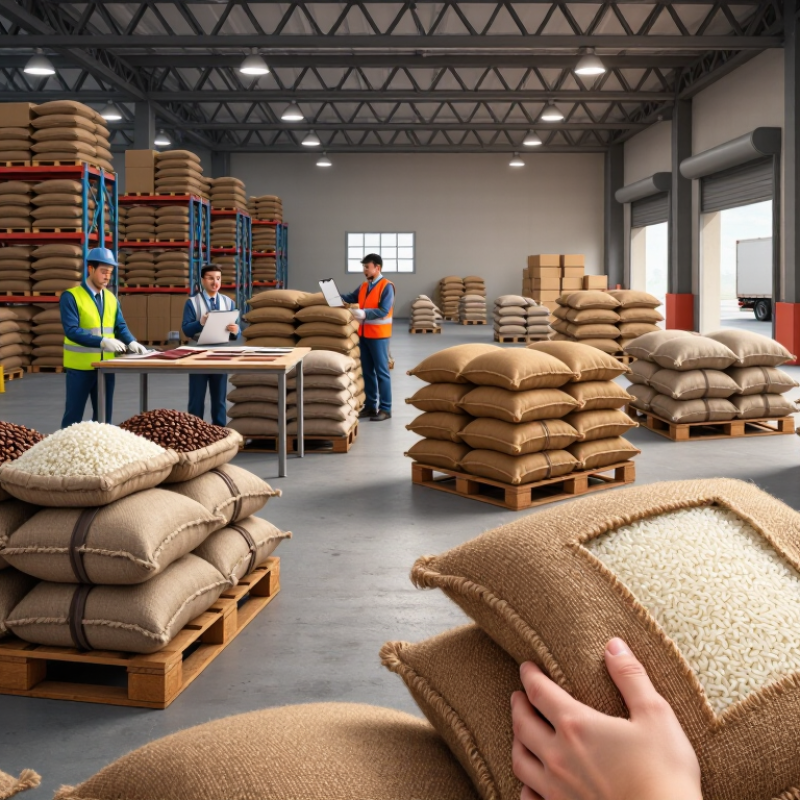
Define the end use before requesting quotations. A jute sack for coffee beans faces different demands from one carrying grain, roots, or garden materials. Record the product’s density, moisture level, filling temperature, and expected storage period. Then estimate the gross load, lifting method, stacking height, and transport distance.
ISO 21898 focuses on flexible intermediate bulk containers for non-dangerous goods. It addresses construction, testing, safe working load, and handling conditions. A standard jute sack may not fall within its full scope. However, its risk-based approach remains useful for larger woven-fiber containers. Confirm whether the package uses loops, lifting points, or pallet handling. Those details affect seam strength and load distribution.
Request test evidence for tensile strength, seam resistance, drop performance, and fabric permeability. Check the sack with the real filling material, not only an empty sample. A 50-kilogram load can shift sharply during forklift movement. Moisture can also weaken untreated jute and encourage odor or mold. Ask for the safe working load, safety factor, dimensions, closure method, and storage limits in writing.
A practical inspection should include visual checks for loose fibers, uneven weaving, damaged seams, and inconsistent sizing. Measure several samples. Natural fibers vary.
That variation matters. My first sample may look strong but fail after humid storage. Repeated testing is less convenient, yet it prevents costly assumptions. Include batch identification and inspection records for every shipment.
How to Choose the Best Jute Sack for Global Sourcing?
FAOSTAT’s Crops and Livestock Products database shows India and Bangladesh as the leading jute producers. Its 2022 records indicate combined raw jute output above three million tonnes. This scale matters because larger fiber markets usually offer wider grading experience and steadier supply. However, production volume does not prove better sack quality. FAOSTAT measures fiber output, not tensile strength, weave density, or contamination.
A sourcing team should compare jute grades through physical samples. Examine the fibers under natural light. Long, golden strands usually support stronger yarn and smoother weaving. Short fibers can create uneven surfaces and weak seams. Moisture also deserves attention. The International Jute Study Group has repeatedly identified moisture control as important for storage and transport performance. A sack may look acceptable when dry, then lose strength after humid handling. That unpleasant surprise is easy to underestimate.
Tips: Request samples from at least two production regions. Record fiber color, odor, seam strength, and measured weight. Ask suppliers to connect their grade claims with FAOSTAT production data and independent laboratory tests. Do not treat a country’s output as a quality certificate. I have found that simple drop tests often reveal problems missed by polished specifications. Still, one test is not enough. Repeat testing after humidity exposure, because real warehouses are rarely perfect. Consider ASTM or ISO test methods where suitable, but confirm the method matches the cargo and shipping route.
How to Choose the Best Jute Sack for Global Sourcing?
The right jute sack begins with the cargo, not the lowest quotation. Specify GSM, or fabric weight, according to the product’s density and handling conditions. Light agricultural produce may suit 280–320 GSM fabric. Dense materials often need 400 GSM or more, especially during stacking and transport. These figures are practical starting points, not universal rules.
Ply selection matters when one fabric layer cannot resist abrasion. Two-ply construction adds protection, but it also increases weight and cost. Ask suppliers to state the yarn quality and ply arrangement clearly. Stitching deserves equal attention. A double-stitched mouth can reduce tearing during filling, while reinforced corners help with repeated handling. I have seen strong fabric fail because the seam allowance was too narrow.
Tensile strength should be specified in both warp and weft directions. Request test values, test methods, and recent laboratory reports. Seam strength should be tested separately from fabric strength. That detail is often missed. For long-distance sourcing, test filled sacks under stacking pressure, vibration, and moderate humidity. Jute absorbs moisture, so storage ventilation matters. A sack that performs well in a dry warehouse may weaken after weeks in damp conditions. I would also confirm dimensions after filling, since an over-tight sack can stress every stitch. Suppliers should provide pre-production samples, although samples cannot represent every batch perfectly.
| Intended Cargo | Recommended Capacity | Fabric Weight (GSM) | Construction | Typical Sack Size | Stitching Specification | Minimum Tensile Strength | Moisture & Liner Guidance | Recommended Closure | Why This Specification Works |
|---|---|---|---|---|---|---|---|---|---|
| Coffee Beans | 60–70 kg | 275–320 g/m² | 2-ply jute warp and weft fabric | 70 × 110 cm | Double-stitched top; lockstitch or chain stitch; reinforced side seams | Warp: ≥ 700 N Weft: ≥ 600 N |
Use clean, dry, food-contact-suitable fabric. Add a breathable inner liner when aroma protection or additional cleanliness is required. | Fold-over hem with sewn closure or drawstring | Balances breathability, abrasion resistance, and sufficient strength for handling and stacking. |
| Cocoa Beans | 60–65 kg | 285–330 g/m² | 2-ply, closely woven jute fabric | 70 × 105 cm | Double-sewn mouth and bottom seam; minimum 8 stitches per 10 cm | Warp: ≥ 750 N Weft: ≥ 650 N |
Keep moisture below the cargo’s permitted export level before packing. Avoid impermeable liners if ventilation is needed during storage. | Machine-sewn top with folded hem | The denser weave helps reduce fiber loss and withstand repeated manual handling. |
| Rice and Other Grain | 25–50 kg | 250–300 g/m² | 2-ply jute fabric; optional tighter weave for fine grains | 55 × 90 cm or 65 × 100 cm |
Double bottom seam; reinforced mouth; bartack at stress points | Warp: ≥ 650 N Weft: ≥ 550 N |
Use dry grain only. A food-grade PP or PE liner may be specified where protection from humidity or leakage is necessary. | Folded and sewn top, or tie closure for short-distance handling | Provides adequate load support while maintaining a practical weight and cost for bulk agricultural goods. |
| Potatoes and Root Vegetables | 25–50 kg | 240–290 g/m² | 2-ply, breathable jute fabric with medium weave | 55 × 85 cm or 60 × 95 cm |
Single or double top seam; reinforced bottom corners; smooth internal stitching | Warp: ≥ 600 N Weft: ≥ 500 N |
Do not use a fully sealed liner for fresh produce unless condensation is controlled. Store in a cool, dry, ventilated area. | Open-mouth sewn hem or drawstring | Breathability helps reduce heat and condensation buildup, while the woven structure supports ventilation. |
| Onions and Garlic | 20–40 kg | 220–270 g/m² | 2-ply open or medium weave | 50 × 80 cm or 55 × 90 cm |
Reinforced mouth and bottom; minimum 7 stitches per 10 cm | Warp: ≥ 550 N Weft: ≥ 450 N |
Select breathable fabric to support curing and ventilation. Keep the sack dry before filling and during transit. | Drawstring, sewn top, or laced closure | Lower GSM and a more open weave improve airflow while remaining suitable for moderate loads. |
| Animal Feed and Seeds | 25–50 kg | 260–310 g/m² | 2-ply tightly woven jute fabric | 55 × 90 cm or 65 × 100 cm |
Double-stitched seams; folded mouth; reinforced bottom seam | Warp: ≥ 680 N Weft: ≥ 580 N |
Use clean, odor-free sacks. Add an inner liner for fine seed, powdery feed, or protection against external moisture. | Machine-sewn closure | A tighter weave limits leakage of small particles and improves resistance to abrasion during distribution. |
| Flour and Powdered Agricultural Products | 25–50 kg | 300–360 g/m² | 2-ply close-weave jute fabric with liner | 55 × 90 cm or 65 × 100 cm |
Double-stitched seams; enclosed or bound seam allowance; reinforced corners | Warp: ≥ 750 N Weft: ≥ 650 N |
Use a food-grade inner liner to control powder leakage and humidity exposure. Confirm liner compatibility with the cargo. | Heat-sealed or sewn liner plus sewn jute closure | Higher GSM and a liner improve containment, cleanliness, and protection against handling damage. |
| Charcoal and Firewood Pieces | 20–40 kg | 300–380 g/m² | 2-ply heavy jute fabric | 55 × 85 cm or 60 × 95 cm |
Heavy-duty double stitching; reinforced base; bound or covered seams | Warp: ≥ 800 N Weft: ≥ 700 N |
Pack only when the cargo is completely cool and dry. The sack is not a substitute for fire-resistant or hazardous-material packaging. | Heavy sewn closure or laced top | Higher GSM and reinforced seams help resist puncture, abrasion, and rough loading conditions. |
| Natural Fibers and Agricultural Waste | 30–60 kg | 280–340 g/m² | 2-ply medium-to-heavy jute fabric | 60 × 100 cm or 70 × 110 cm |
Double-stitched mouth and bottom; optional internal seam binding | Warp: ≥ 700 N Weft: ≥ 600 N |
Use a breathable sack for dry materials. For dusty cargo, specify a closer weave or a compatible inner bag. | Fold-over sewn top or drawstring | Offers a practical combination of capacity, breathability, and durability for irregular-shaped loads. |
| Export Display or Reusable Retail Sacks | 10–25 kg | 250–320 g/m² | 2-ply fine-weave jute fabric | 40 × 60 cm or 45 × 70 cm |
Clean double top stitch; hemmed opening; optional webbing handles | Warp: ≥ 600 N Weft: ≥ 500 N |
Use clean, low-odor fabric. Add a liner when the sack will directly contact food or finely processed goods. | Drawstring, zip closure, or sewn flap | Fine weave and neat stitching improve appearance and reusability without requiring excessive fabric weight. |
How to Choose the Best Jute Sack for Global Sourcing?
Moisture is the first export risk to verify. A sack may feel dry outside but retain dampness in its inner weave. That hidden moisture can encourage mold, odor, staining, and weaker seams during a long voyage. FAO’s State of Food and Agriculture 2019 reports that 13.2% of food is lost between harvest and retail. Poor packaging control can add to this loss. Ask suppliers for batch moisture records, storage conditions, and test methods. Do not accept “dry” as a complete specification. Set a measurable limit for both the jute fabric and packed goods.
Food-contact compliance needs equal attention. Request a declaration covering dyes, finishes, sewing thread, and inner liners. Check the destination market’s rules, such as EU Regulation (EC) No 1935/2004 or relevant national requirements. A food-contact statement without laboratory evidence is weak. Testing should match the actual product, oil content, temperature, and contact duration. Codex General Principles of Food Hygiene, CXC 1-1969, supports risk-based control, but it does not replace local legal checks. One overlooked detail can invalidate an otherwise strong shipment.
Tips: Sample several sacks from each production lot. Use an independent laboratory when the cargo is sensitive. Confirm whether pallets or wooden crates require ISPM 15 treatment and marking. ISPM 15 applies to wood packaging, not jute sacks. Photograph marks before loading. Recheck moisture after container stuffing; port delays can change conditions. This step is often skipped. It should not be.
Capacity is not a brochure number. Ask for audited monthly output, current utilization, and backup production lines. A supplier producing 500,000 sacks monthly may have little room during harvest season. Request shipment records from the past twelve months. Compare confirmed capacity with your peak order, not your average demand.
Lead time also needs separate tracking. Measure material preparation, stitching, inspection, port handling, and ocean transit. The World Bank’s 2023 Logistics Performance Index evaluates customs, infrastructure, international shipments, logistics competence, tracking, and timeliness. Use these dimensions when reviewing the supplier’s export route. UNCTAD’s Review of Maritime Transport 2024 notes that shipping carries over 80% of global merchandise trade, so port reliability can change your delivery plan quickly.
Defect rates deserve evidence. Request AQL inspection reports, corrective-action records, and sample photos showing loose stitching, weak seams, odor, and size variation. ISO 2859-1 provides a recognized framework for lot sampling, but an acceptable sample result does not guarantee every sack is perfect. That limitation matters.
Calculate total landed cost, including unit price, inspection, rework, inland transport, freight, duties, storage, and delays. The lowest quotation can become expensive after one rejected container.
Tips: Build a supplier scorecard with capacity, lead time, defect rate, and landed cost. Require a pilot order before annual volume. Record promised and actual dates. Review three shipments, not one. Be cautious with impressive claims. They may be true, but they still need documents.
We are the most reliable and proficient jute goods manufacturer & supplier that helps businesses or individuals with various exportable agricultural commodities biz and jute goods by shipping them worldwide. Our right-time service ensures that whatever color and size of jute product you need, we can make it happen anytime and anywhere! Let’s keep our earth safer to live in!
Important link
Address
Bangladesh Address:
Fair Plaza (9th Floor), Plot : 3C, Section : 01, Mirpur, Dhaka:1216
UK Office:
242 Manor Road, Droylsden, Manchester, M43 6JD, United Kingdom.
Let's Talk
We are the most reliable and proficient jute goods manufacturer & supplier that helps businesses or individuals with various exportable agricultural commodities biz and jute goods by shipping them worldwide. Our right-time service ensures that whatever color and size of jute product you need, we can make it happen anytime and anywhere! Let’s keep our earth safer to live in!
Bangladesh Address:
Fair Plaza (9th Floor), Plot : 3C, Section : 01, Mirpur, Dhaka:1216
UK Office:
242 Manor Road, Droylsden, Manchester, M43 6JD, United Kingdom.