How to Choose the Right Plastic Bag for Your Business?
Choosing the right Plastic Bag begins with your product, customers, and daily operating conditions. A bakery may need clear bags that resist grease. A hardware supplier may require stronger film and reliable handles. An online retailer may value clean presentation, easy storage, and practical sizing. The cheapest option can become expensive when seams split, products shift, or customers struggle to carry purchases.
Tom Szaky, founder of TerraCycle and a respected waste-management entrepreneur, says, “There is no such thing as waste, only stuff in the wrong place.” His observation encourages businesses to examine the bag’s entire journey. Consider the material, thickness, dimensions, printing, reuse potential, and available disposal systems. A lightweight bag may reduce material use, but it can fail under pressure. A thicker bag may last longer, yet demand more resources. The better decision depends on real use, not attractive claims.
Start with evidence from your workplace. Measure the heaviest products. Test filled bags at the counter. Leave samples in storage areas with heat, moisture, or dust. Small details matter. Check handle comfort, sealing quality, odor, and transparency. Also review applicable packaging requirements and supplier documentation before ordering. Certifications should be verifiable, not merely printed in bold.
There is no perfect Plastic Bag.
Some choices will remain uncertain. Customer behavior, recycling access, and regional infrastructure can change quickly. Still, a careful comparison creates a more reliable purchasing decision. This guide explores the main bag types, material choices, performance questions, and practical checks businesses should consider before committing to a supplier.
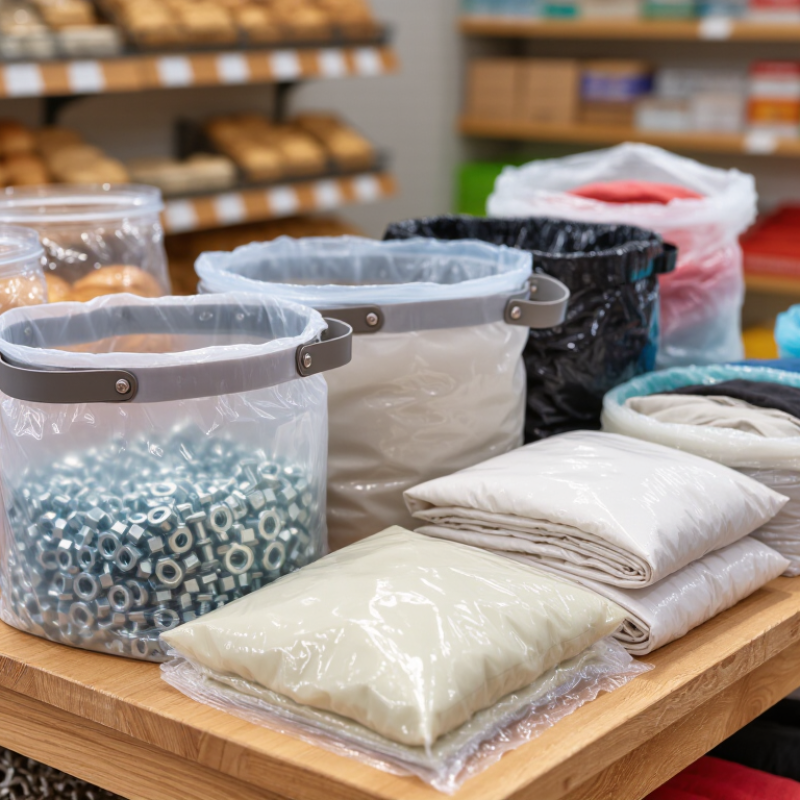
Define the Load Profile and Select a 15–200 μm Film Thickness
How to Choose the Right Plastic Bag for Your Business?
Define the load profile before choosing film thickness. Record the product’s weight, shape, edges, moisture, and packing method. A soft, dry product may work well with 15–40 μm film. Heavy goods often need 60–120 μm for better puncture resistance. Very sharp or demanding loads may require 150–200 μm film.
Thickness is not the only performance factor. Resin quality, seal strength, bag dimensions, and storage temperature also affect reliability. In practical packaging trials, a thicker bag sometimes failed because its seal was weak. A thickness chart helps, but it can mislead. Test filled bags during lifting, stacking, and drop handling. Watch for stretching, pinholes, split corners, and seal separation. Record failures honestly. Small flaws can reveal a poor load assumption.
Tips: Start with the lightest suitable thickness. Test three thickness levels when possible. Use real products, not empty samples. Check bags after transport simulation. Review the result with warehouse staff, because they notice handling problems quickly. Some load profiles remain unclear; that is a reason to test again, not to guess.
How to Choose the Right Plastic Bag for Your Business?
Define the load profile and select a film thickness between 15–200 μm.
Recommended thickness increases with product weight, edge sharpness, and handling stress. Lightweight liners may use 15–40 μm film, while heavy-duty sacks for dense or abrasive materials commonly require approximately 100–200 μm. Final selection should be verified through drop, puncture, seal, and transport testing.
Match LDPE, HDPE, or LLDPE to Strength, Clarity, and Flexibility
Choosing the right plastic bag starts with the product’s handling conditions. LDPE offers a softer feel, useful clarity, and easy sealing. It suits garments, bakery items, and light retail goods. HDPE feels stiffer and more opaque. Its strong film works well for groceries, liners, and heavier contents. LLDPE usually provides better puncture resistance and stretch, making it valuable for dense or irregular products.
The Flexible Packaging Association reported that the United States flexible packaging industry reached about 39 billion dollars in sales in 2022. PlasticsEurope also reported that packaging represented 39.3% of European plastics demand in 2022. These figures show the scale of the sector, but market size does not choose your resin. Test the actual bag, not only the material name. ASTM D882 can measure tensile properties, while ASTM D1709 helps evaluate impact strength. Film thickness, sealing temperature, additives, and bag shape can change results significantly. A clear LDPE bag may still tear at a sharp corner. A strong LLDPE film may look less transparent than expected.
Tips: Match the resin to the failure you fear most. Choose LDPE for softness and appearance, HDPE for stiffness, and LLDPE for toughness. Request samples at the final thickness. Fill them with real products, stack them, and drag them across a warehouse floor. Record leaks, stretching, seal opening, and visibility. My practical caution is simple: a laboratory result can look excellent, yet an awkward carton or rushed sealing process may expose the wrong choice.
Set Bag Size, Seal Type, and Capacity Using ASTM D4169 Testing
How to Choose the Right Plastic Bag for Your Business?
Bag selection should begin with evidence, not appearance. ASTM D4169-23 provides distribution testing practices for shipping containers and systems. Its methods simulate vibration, compression, impacts, and warehouse handling. These stresses expose weak seals and undersized bags before customers do.
Set the bag size around the product’s actual dimensions. Measure length, width, height, and usable headspace. Then test the filled bag under expected load. A bag that looks spacious may still strain at the corners. A tight fit can cause seal distortion during compression. Seal type matters too. Heat seals, zipper seals, and pressure-sensitive closures behave differently under vibration and temperature changes. Test the finished package, not only the empty film.
Capacity claims also need practical verification. Flexible Packaging Association research places packaging at about 40% of global plastic waste, according to the OECD’s Global Plastics Outlook. Right-sizing can reduce unnecessary material, but thinner is not always better. ASTM D4169 testing should reflect the real distribution cycle, including stacking height and drop exposure. A 10-kilogram load may pass in a calm warehouse and fail during repeated truck vibration. That result deserves attention. Sometimes our first specification is simply wrong. Use measured fill weight, seal strength, leak checks, and post-test inspection to refine the design.
Verify Recycled Content and Environmental Claims Under ISO 14021
How to Choose the Right Plastic Bag for Your Business?
A recycled-content claim should begin with evidence, not attractive wording. ISO 14021 provides guidance for self-declared environmental claims. It also distinguishes pre-consumer and post-consumer recycled material. Ask suppliers to state the recycled percentage clearly. Confirm whether the percentage refers to total bag weight. A vague phrase like “eco-friendly material” proves very little.
Request a written declaration, material specifications, production records, and recent purchase documents. These records should connect the recycled resin to the finished bag. Check whether the evidence covers the correct thickness, color, and bag format. A certificate alone may not verify the exact product. ISO 14021 does not automatically turn every environmental statement into an independent certification. The claim must remain accurate, specific, and understandable.
Look closely at samples. Measure thickness, inspect seals, and test load performance with the products your business actually carries. Recycled content can vary between production batches. That variation deserves attention. A lower percentage with reliable documentation may be more credible than a higher percentage without supporting records. Suppliers should also explain their calculation method and identify any excluded materials, inks, or handles. Documents can contain gaps. I have found that simple questions often reveal them. No review is perfect, and recycled content does not excuse poor bag performance. A bag that tears during delivery can create waste, complaints, and unnecessary replacement orders.
Assess Compostable Bags Against EN 13432’s 90% Biodegradation Benchmark
How to Choose the Right Plastic Bag for Your Business?
A compostable bag should be judged against EN 13432, not attractive packaging claims. The standard requires at least 90% biodegradation within six months under controlled industrial composting conditions. It also requires 90% disintegration within twelve weeks, with strict limits on toxic residues and heavy metals. These tests commonly use controlled laboratory methods, including ISO 14855. Real collection systems can be less predictable.
Market growth is encouraging, but it also creates confusion. European Bioplastics and nova-Institute’s 2023 market report estimated global bioplastics production capacity at about 2.18 million tonnes in 2023. Yet capacity does not prove local composting access. A bag may pass EN 13432 testing and still remain visible in a home compost bin. That uncomfortable gap matters. The Ellen MacArthur Foundation’s 2023 Global Commitment report also shows that packaging waste reduction remains difficult across supply chains. Certification helps, but it is not a magic passport.
Tips: Ask suppliers for current EN 13432 test reports, not only marketing sheets. Check whether your waste contractor accepts certified compostable bags. Match the bag’s thickness to its real load, such as wet food scraps or sharp retail items. Test a small batch first. Document failures honestly. A thinner bag may reduce material use, but tearing can increase waste and customer complaints. The best choice depends on disposal infrastructure, product weight, storage conditions, and verified performance.