How to Choose the Right Water Control Gate for Your Project?
Choosing the right water control gate begins with the site, not the product catalogue. Flow rate, head pressure, channel width, sediment, debris, and corrosion determine the suitable design. A gate that performs well in a clean irrigation canal may fail in a stormwater channel filled with branches and gravel. Field measurements matter.
Industry reports show why this decision deserves careful engineering. The UNESCO World Water Development Report 2024 states that agriculture accounts for approximately 70% of global freshwater withdrawals. This scale increases pressure on irrigation efficiency and reliable flow regulation. The World Bank’s High and Dry report also identifies water scarcity as a growing economic and operational risk. Meanwhile, the U.S. Army Corps of Engineers’ EM 1110-2-1602 provides detailed guidance for hydraulic design, outlet works, and gate-related structures.
These sources support a practical selection process. Compare slide, sluice, flap, radial, and vertical-lift gates against actual operating conditions. Check the gate’s rated head, leakage tolerance, operating frequency, actuator capacity, and maintenance access. Ask how the system behaves during power loss. It matters.
A visible handwheel, protected stem, and reachable inspection platform can reduce future downtime. Material choices also deserve attention. Stainless steel, coated carbon steel, and elastomer seals perform differently under abrasive sediment or saline water. However, no report can replace a project-specific hydraulic model and site inspection. That assumption can fail. Designers should verify calculations with qualified engineers, documented standards, and manufacturer data. The best water control gate is not always the most expensive option. It is the one that controls water safely, predictably, and economically throughout its intended service life.
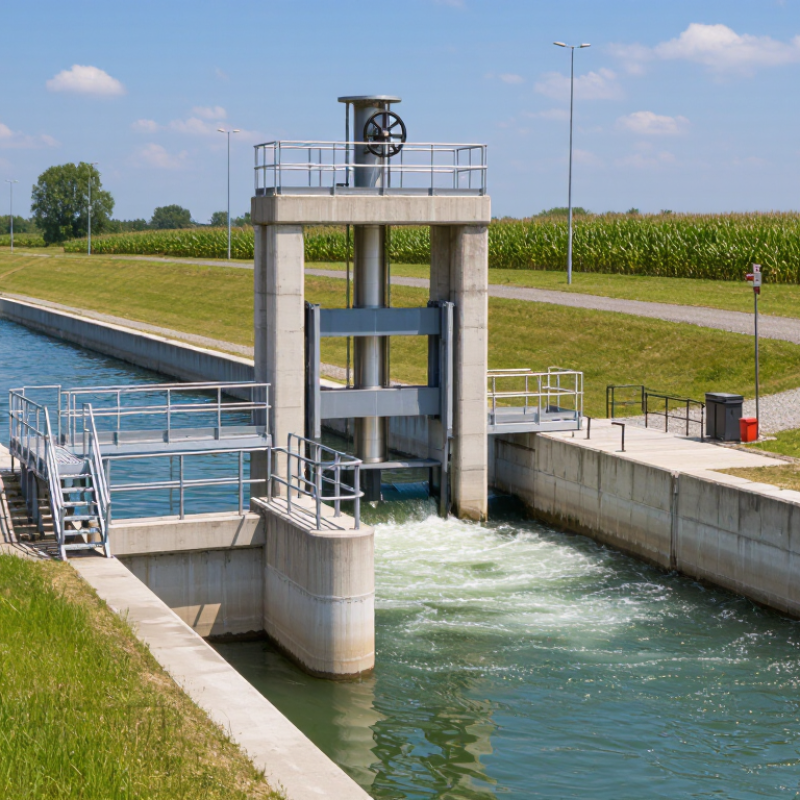
Define Your Project’s Water Control Requirements
Choosing a water control gate begins with defining the water, not browsing equipment catalogs. Record normal and peak flow rates, upstream and downstream levels, and required closure time. Measure the channel opening at several points; old concrete is rarely perfectly square. Note sediment, floating debris, temperature, salinity, and chemicals. These details affect gate materials, sealing, and actuator selection. A gate facing clean irrigation water may fail in abrasive, debris-filled runoff.
Clarify what the gate must do during ordinary and emergency conditions. Will it isolate a pipeline, regulate a reservoir, protect a stormwater outlet, or prevent backflow? A regulating gate needs controlled movement and stable partial openings. An isolation gate may prioritize tight shutoff and dependable full closure. Calculate hydraulic head, including sudden pressure changes, rather than using average water depth alone. Specify manual, electric, or hydraulic operation, plus access, backup power, alarms, and inspection space. Keep maintenance practical. If technicians cannot reach the seals, a strong design becomes a future problem.
Translate these findings into measurable requirements and request an independent hydraulic or civil engineering review. Applicable codes and site permits should guide materials, guarding, electrical work, and discharge controls. Ask suppliers for load calculations, leakage expectations, corrosion assumptions, testing records, and installation tolerances. Do not accept vague claims of “heavy duty.” A clear data sheet protects the budget and operators. Still, uncertainty remains. Rainfall estimates change, and sediment behavior is easy to underestimate. Add reasonable capacity margins, then document why they were chosen. The best specification matches actual site behavior.
Compare Gate Types for Different Flow Control Needs
How to Choose the Right Water Control Gate for Your Project?
Choosing a water control gate starts with the flow, not the catalog. Slide gates suit channels, tanks, and moderate-head applications requiring reliable isolation. They are compact and simple to inspect. However, sealing performance can decline when debris collects along the frame. Flap gates work well for one-way drainage and flood discharge. They open through water pressure and close during reverse flow. Radial gates handle wider openings and higher loads with less lifting force. Their curved design can reduce operating effort, but structural calculations become more demanding.
Site conditions often change the decision. Measure normal flow, peak flow, water depth, sediment, and expected debris before selecting a gate. In field inspections, I have seen small branches stop poorly protected mechanisms. A gate that looks oversized may prevent costly shutdowns later. Automation also matters. Electric or hydraulic operators improve control, yet they need protected controls and regular testing. Manual operation can be dependable in remote locations, but only when access remains safe.
Tips: Match the gate to both normal and emergency flow. Check leakage limits with the project engineer. Leave room for maintenance tools. Review corrosion protection for wet, chemically active environments. Do not assume the cheapest gate is the most economical. Installation errors can weaken excellent equipment. I once underestimated sediment buildup during planning; the maintenance schedule needed revision. That mistake reinforced a practical lesson: select the gate with real operating conditions, not ideal drawings, in mind.
Select the Appropriate Gate Size and Operating Capacity
Gate sizing starts with the design discharge, not the opening width. A 1% annual-exceedance flood has a 1% chance of occurring each year, according to FEMA flood-risk guidance. Use that value only when it matches the project’s required protection level. Record normal flow, peak flow, upstream water level, downstream tailwater, and debris conditions. Then calculate capacity with Q = CdA√(2gH), while checking the manufacturer’s discharge coefficient. Small errors matter.
A gate passing 10 m³/s may need a much larger opening when available head is low. For example, doubling head increases theoretical flow by only about 41%, not 100%. Size the actuator for static load, friction, sediment, ice, and emergency closure. The U.S. Bureau of Reclamation Design Standards No. 14 recommends evaluating normal, flood, seismic, and maintenance load cases. The U.S. Army Corps of Engineers also stresses hydraulic transients and structural stability in its hydraulic design manuals. Do not ignore tailwater.
Operating capacity needs a practical margin. A gate that runs continuously at its maximum rating may have little resilience during storms. Many designs examine at least the selected design flow plus a controlled allowance, but the margin must reflect site risk and equipment limits. This is where judgment matters. Field debris can defeat a perfect calculation. Recheck the assumed flow data after commissioning, because rainfall patterns and catchment conditions change. A spreadsheet is useful. It is not the project.
How to Choose the Right Water Control Gate for Your Project?
Select a gate size that provides sufficient flow capacity under the expected hydraulic conditions. The chart estimates discharge for common gate widths with a 0.50 m opening and 1.00 m upstream head.
Estimated capacity is calculated using Q = Cd × A × √(2gH), with a discharge coefficient of 0.62, gravitational acceleration of 9.81 m/s², and the stated opening and head conditions. Final gate selection should also consider site hydraulics, debris loading, corrosion, lifting equipment, safety margins, and required operating frequency.
Review Installation, Maintenance, and Lifecycle Costs
Choosing a water control gate requires more than comparing purchase prices. Installation can include excavation, concrete work, lifting equipment, electrical connections, and temporary flow control. A gate that looks affordable may demand costly site modifications. Review access carefully: can technicians reach the seals, stem, and actuator without entering confined spaces? Small design oversights become expensive during shutdowns.
Maintenance deserves equal attention. Specify inspection intervals, corrosion protection, seal replacement, lubrication, and spare-part availability. The U.S. Environmental Protection Agency’s 2024 Clean Watersheds Needs Survey estimates $630.1 billion in wastewater and stormwater infrastructure needs through 2041. That figure reinforces a practical lesson: owners must budget for asset care, not only construction. ASCE’s 2021 Infrastructure Report Card rated wastewater infrastructure D+ and stormwater infrastructure D. Deferred maintenance is not a harmless delay.
Lifecycle costing should include energy use, labor, downtime, rehabilitation, and eventual replacement. ISO 15686-5 recommends whole-life cost analysis for built assets, rather than relying on initial price alone. I would test at least three operating scenarios: normal flow, emergency closure, and sediment-heavy conditions. Ask contractors for documented installation hours and maintenance records from comparable projects. Estimates can still be imperfect. That is acceptable, if assumptions are visible and reviewed annually. A slightly higher initial cost may reduce leaks, emergency callouts, and unsafe manual work over twenty years.