
Indoor air can look clean while carrying odors, smoke residues, and volatile organic compounds. An activated carbon filter sheet helps address these invisible pollutants through adsorption. Its porous carbon structure captures certain gas molecules as air passes across the surface. This differs from a particle filter, which mainly traps dust, pollen, and airborne fibers.
The difference matters.
In practical air-purification systems, engineers often combine carbon media with mechanical filtration. The particle layer protects airflow performance, while carbon targets unwanted smells and selected chemical vapors. Performance depends on carbon quality, sheet thickness, airflow speed, humidity, and pollutant concentration. A thin sheet may reduce light odors, but it cannot remove every gas indefinitely. That limitation is easy to overlook.
Real-world results vary.
A kitchen, office, or workshop may require different filter designs. For example, a sheet facing cooking odors can become saturated faster than one used in a quiet bedroom. Regular replacement is essential because exhausted carbon may stop working without obvious visual warning. Product testing, clear technical data, and proper installation provide stronger evidence than attractive packaging claims. Reliable manufacturers should identify carbon loading, pressure drop, target pollutants, and recommended service intervals.
This guide examines why an activated carbon filter sheet remains useful for modern air purification. It also considers its practical weaknesses, maintenance needs, and best-use conditions. No filter is perfect. Understanding those boundaries leads to safer, more realistic choices.
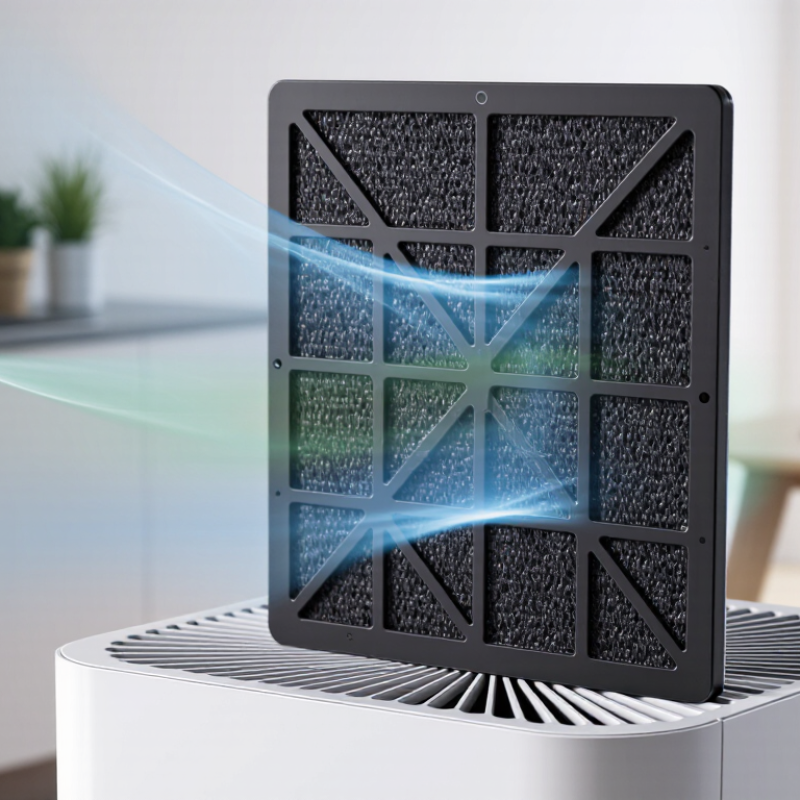
An activated carbon filter sheet is a porous filter material containing carbon treated to create millions of tiny internal spaces. These spaces attract and hold many gaseous pollutants through adsorption. The carbon does not simply trap particles like a dust filter. It interacts with odor molecules and certain volatile organic compounds as air passes through the sheet.
Most sheets use a fibrous support layer to keep carbon evenly distributed. Some contain carbon granules, while others use carbon powder bonded to a nonwoven fabric. This structure affects airflow, strength, and contact time. A thicker sheet often provides more carbon, but it may also create greater resistance for a fan. Good design requires balance.
Performance depends on conditions. High humidity can occupy adsorption sites and reduce capacity. Strong odors may also return when the carbon becomes saturated. That point is easy to miss. A practical check includes monitoring odor changes, airflow, and replacement intervals. A sheet that looks clean may already be exhausted. Activated carbon also does not remove every airborne particle, so it usually works alongside a particle filter.
In indoor use, the sheet may help reduce cooking odors, smoke-related smells, and some chemical vapors. Results vary with carbon quality, pollutant concentration, and air volume. Careful testing matters. My own critical view is simple: carbon quantity deserves more attention than attractive filter appearance.
| Data Dimension | Typical Information | Practical Relevance |
|---|---|---|
| Definition | A porous filter media sheet containing activated carbon, often combined with a fibrous support layer. | It provides particulate support while adsorbing selected gaseous contaminants. |
| Primary purification mechanism | Adsorption: gas molecules adhere to the internal surface of activated carbon pores. | Useful for reducing odors and certain volatile organic compounds (VOCs). |
| Typical target pollutants | Odor molecules, some VOCs, and selected gaseous contaminants. | Performance depends on carbon type, mass, contaminant concentration, humidity, and contact time. |
| Particle filtration capability | Usually limited unless the sheet includes a dedicated particulate-filter layer. | A separate or composite particle filter may be needed for fine particles such as PM2.5. |
| Common carbon materials | Activated carbon made from sources such as coconut shells, wood, or coal. | The raw material and activation process influence pore structure and adsorption behavior. |
| Available forms | Flat sheets, rolls, pleated panels, and laminated composite media. | Sheet formats can be cut or integrated into air purifiers, ventilation units, and odor-control systems. |
| Pressure-drop considerations | Air resistance increases with greater media thickness, density, pleat depth, and loading. | The filter should be matched with the fan or air-handling system to maintain adequate airflow. |
| Humidity sensitivity | High relative humidity can compete with some pollutants for adsorption sites and reduce performance. | Results may vary significantly in damp environments or when treating humid air. |
| Service life | Not fixed; it depends on pollutant load, airflow, humidity, carbon quantity, and operating hours. | Replacement should follow pressure-drop changes, odor breakthrough, manufacturer guidance, or application testing. |
| Key advantages | Low-profile construction, flexible installation, odor reduction, and compatibility with multi-stage filtration. | Suitable where space is limited and gas-phase contaminant control is required. |
| Main limitations | It does not remove every gas, does not replace ventilation, and may become saturated. | Filter selection should be based on the specific contaminant, concentration, airflow, and required removal level. |
| Typical applications | Residential air purifiers, HVAC systems, ventilation equipment, odor-control units, and enclosed cabinets. | The appropriate grade and thickness depend on the air volume and contaminant profile. |
| Recommended evaluation criteria | Carbon loading, sheet thickness, basis weight, air permeability, pressure drop, adsorption data, and dimensions. | Comparing these specifications helps determine whether the sheet fits the intended purification system. |
Note: Performance values vary by filter construction, test conditions, pollutant type, airflow, temperature, and humidity. Product specifications and application testing should be reviewed before use.

Activated carbon captures airborne pollutants through adsorption, not absorption. Its porous surface acts like a microscopic sponge, holding gas molecules inside millions of tiny pores. This mechanism can reduce odors, smoke-related compounds, and volatile organic compounds (VOCs) released from paints, adhesives, and cleaning products. The U.S. Environmental Protection Agency reports that indoor VOC levels can be two to five times higher than outdoor levels, and sometimes much higher after product use. A carbon filter sheet can therefore be useful near kitchens, workshops, or newly furnished rooms.
The material has limits. It does not reliably remove fine particles such as PM2.5 unless combined with a particle filter. The World Health Organization’s 2021 Air Quality Guidelines set an annual PM2.5 guideline of 5 µg/m³, showing why particle control still matters. Carbon performance depends on carbon mass, pore structure, airflow speed, humidity, and contact time. Fast airflow may leave pollutants untreated. Thin sheets can also become saturated sooner than expected. Real rooms are messier than laboratory tests. A practical design should include regular replacement, airflow testing, and measurements matched to the target pollutant. Smell alone is not proof of clean air. EPA and ASHRAE guidance both support source control and ventilation alongside filtration, rather than treating activated carbon as a complete solution.
activated carbon filter sheets help reduce odors and selected gaseous pollutants indoors. Their porous carbon structure adsorbs molecules from cooking fumes, smoke residue, and some volatile organic compounds. This can make a noticeable difference in kitchens, offices, and recently renovated rooms. The benefit is practical: air may smell cleaner without adding fragrance.
However, activated carbon does not replace a particle filter. It cannot reliably capture dust, pollen, or fine particles by itself.
In daily use, performance depends on carbon quantity, airflow, humidity, and contact time. A thicker sheet may hold more contaminants, but it can also restrict airflow. Check the filter’s test data instead of trusting appearance alone.
Replace it when odors return, airflow drops, or the recommended service period ends. In my experience, delayed replacement is a common mistake. A filter can look clean and still be exhausted.
Results also vary between rooms, so indoor air testing may be worthwhile when symptoms persist.
Tips: Seal the sheet firmly around its frame. Avoid gaps along the edges. Keep it away from water and excessive humidity. Combine it with a certified particle filter for broader air cleaning. Record installation dates, then inspect the sheet monthly. Performance is not always obvious. Reliability improves when maintenance follows measured conditions, not guesswork.
Activated carbon filter sheets are useful when air contains odors, vapors, or certain gaseous pollutants. Their porous carbon surface captures molecules through adsorption. However, they are not universal dust filters. A practical system often pairs carbon with a particle-filtering layer.
Choosing the sheet requires more than checking carbon weight. Look at carbon type, thickness, air resistance, and target contaminants. A thicker sheet may hold more carbon, but it can restrict airflow. Measure the fan’s capacity and room air-change needs before selecting it. Check tested removal data, not only general claims. Testing should identify pollutants, airflow, humidity, and breakthrough time. Humid air can reduce performance for some contaminants. Small details matter.
Seal quality is equally important. Air escaping around the sheet receives no treatment. Choose a size that fits firmly, while allowing replacement without damaging the frame. Ask how the material performs after storage and repeated use. There is no fixed replacement date for every room. Odor return, rising pressure, or test results may signal exhaustion. In my experience, users often wait too long because the sheet still looks clean. That is a mistake. Yet replacement based only on smell is imperfect, since some pollutants have little odor. Reliable decisions combine test documents, operating conditions, and periodic inspection.
Activated carbon generally adsorbs medium- and high-boiling-point VOCs more readily than highly volatile gases. The chart shows approximate boiling points at atmospheric pressure for common indoor-air contaminants. Filter selection should also consider carbon loading, sheet thickness, air velocity, humidity, contact time, and pressure drop. Formaldehyde and other low-boiling gases may require specially impregnated carbon rather than standard activated carbon alone.
Activated carbon filter sheets help reduce many odors and gaseous pollutants in indoor air. Their performance depends heavily on correct installation.
Before fitting one, switch off the air-cleaning unit and check the airflow arrow. The carbon layer must face the incoming air. A loose edge can create bypass airflow, leaving odors untreated.
Measure the frame carefully. Even a small gap matters. If the sheet includes a separate particle filter, place it according to the manufacturer’s instructions.
Maintenance should begin with a visual inspection every two to four weeks.
Look for dust loading, damp spots, warped material, or unusual airflow noise. Carbon media can lose effectiveness before it looks dirty. Rooms with cooking fumes, pets, or renovation dust may require more frequent checks.
That mistake is easy to make.
Replace the sheet when odors return, airflow drops, or the recommended service interval ends.
A pressure reading is more reliable than appearance alone. Record installation dates and room conditions in a simple log.
I once relied only on a calendar, and the filter became ineffective sooner than expected. That experience changed my practice.
Replacement should be done with the unit off, using clean gloves to avoid transferring oils and dust. Seal the used sheet before disposal, following local waste requirements.
Performance is never perfectly predictable. Check the air, not just the schedule.
We are the most reliable and proficient jute goods manufacturer & supplier that helps businesses or individuals with various exportable agricultural commodities biz and jute goods by shipping them worldwide. Our right-time service ensures that whatever color and size of jute product you need, we can make it happen anytime and anywhere! Let’s keep our earth safer to live in!
Important link
Address
Bangladesh Address:
Fair Plaza (9th Floor), Plot : 3C, Section : 01, Mirpur, Dhaka:1216
UK Office:
242 Manor Road, Droylsden, Manchester, M43 6JD, United Kingdom.
Let's Talk
We are the most reliable and proficient jute goods manufacturer & supplier that helps businesses or individuals with various exportable agricultural commodities biz and jute goods by shipping them worldwide. Our right-time service ensures that whatever color and size of jute product you need, we can make it happen anytime and anywhere! Let’s keep our earth safer to live in!
Bangladesh Address:
Fair Plaza (9th Floor), Plot : 3C, Section : 01, Mirpur, Dhaka:1216
UK Office:
242 Manor Road, Droylsden, Manchester, M43 6JD, United Kingdom.